I would love to see a city like this built today, but with a little less emphasis on experimental and more on starting with the best practices we know today, and designing for a large scale from the outset like China does.
Things like being designed around pervasive rail-based mass transit, and that being cheaper to build when you don't have to put it in an existing city. Pedestrian optimized streets with much less parking than today's cities. Little-to-no single family zoning, replaced with missing-middle apartment and mixed used neighborhoods. Large parks. Plazas and outdoor dining. Buried utilities. Either rooftop solar, or green roofs everywhere. Modern underground trash collection. Cut-and-cover highway tunnels.
There's a lot of space in Montana, Wyoming, the Dakaotas, and we'll need more space for population there as we have to migrate north.
The vast majority of cities are where they are for a reason. Usually that reason means proximity to some form of transportation infrastructure, whether that be a river, highway, railroad, or ocean. This is true even for Las Vegas, which which some consider to be "built in the middle of nowhere". Any city without a solid economic reason for its existence quickly withers and dies. Sadly, Flint Michigan is an example of this, as are many now-ghost towns in the far west that died after the interstate system was built in the 50s and 60s.
You can't just plop down a fully-furnished city on some unpopulated plot of land and expect anyone to move there. China as you say is trying this, but some of these are basically ghost towns on arrival, despite the massive top-down planning and investment. [1]
Any realistic plan for urban development reform is going to have to work with what exists currently. If you want to create a "demonstration" city from scratch, much faster and cheaper to do it virtually and simulate it.
Half of my family is from Flint, so I'm unfortunately familiar with the flight it, and many nearby towns.
One of the problem with them is that the town itself wasn't compelling enough for people to stay when the primary industry dried up. I think any from-scratch city will need to be very well designed and balanced with features that actually make people want to live there, not just need to because of jobs.
This is where walkable streets, great mass transit, parks, and room for the types of businesses that people actively love (the smaller cafes, shops, venues, etc.) matter most.
At least one major university is critical too, and those can be ramped up rather quickly. UC Merced is only 15 years old with a student population of over 8000.
At its origin, a settlement at Flint made absolute sense because it was at an ideal halfway point[1] between Detroit and Saginaw on the Saginaw Trail[2] in an era where traveling between the two port cities took multiple days. It also had the added bonus of being on the Flint river which made it an ideal focal point for the burgeoning logging industry. The eventual industrialization made it a good location for an automotive plant later on. However, once cars became commonplace and travel between Saginaw and Detroit only took a couple hours, Flint was no longer needed as a stopping location, and ended up primarily existing as a company town for the auto plants, which made it too dependent on the welfare of the auto industry. So once the plants shut down, so did any kind of economic draw to the city.
The lesson being that any city needs a healthy economic ecosystem representing multiple industries in order to sustainably survive, or else it will share Flint's fate.
On a more human side, I worked briefly with some of the people in Flint's startup community and was massively impressed with the optimism and attitude of the people there in the face of their economic situation. It was very inspiring, and I sincerely hope that the state of Michigan is able to manage that city better and leverage what strengths it has and will have in the future.
> You can't just plop down a fully-furnished city on some unpopulated plot of land and expect anyone to move there. China as you say is trying this, but some of these are basically ghost towns on arrival, despite the massive top-down planning and investment. [1]
They are ghost towns on arrival for two reasons.
1. The employer base (say, government ministries) have not yet moved out of their current locations into the newly built cities. They are planned to in the future - and many former ghost cities are now bustling.
2. China has hundreds of millions of people who are trying to stop being subsistence farmers, and urbanize. It's an absolutely unprecedented demographic shift, anywhere in the world. This is a proactive solution for dealing with what would otherwise be the world's biggest housing crunch.
I disagree with China Authoritarianism and it's heavy handed social approach and they surely get a lot of things wrong in engineering and suburban planning too.
But the scale China works at is mind boggling and I couldn't hope to say I could "build a city" better.
> I couldn't hope to say I could "build a city" better.
Because you would probably never make the same trade-offs they do. In the USA we are a little cavalier about eminent domain. In China, the practices go beyond brutal and straight to the inhumane. They will happily displace entire villages to get the job done, and they don’t worry too much about the details of where people end up or how they get compensated.
They also make choices that would be baffling here in the west. For example, they frequently do absolutely nothing to maintain new developments, and often those developments are of unbelievably low quality. With in a year or two, many of them look like they have been crumbling for decades.
Source: Asian family, real estate investments in China.
Yeah, the authoritarian method is brutal beyond compare. But it does let them "get shit done."
Building the pyramids and the great wall and many other "wonders" took literally slave labor for multiple lifetimes and yet somehow people still admire these "achievements". (They have lasted however!)
They need a city, or ten. Not an outhouse. There is no way to build a city and make everyone happy. Do I think they do it best? No, obviously not.
But the Western world would be bogged down in NIMBYism while the chinese engineered cities are built and done.
As for quality... I saw a few things on my holiday trip to China many years ago so I don't doubt poor quality is a thing.
But here in Australia any high rise apartment building built in the past ten years in Sydney or Melbourne is now suspect due to dodgy building practices too. Maybe the building is fine. Maybe it isn't. But they are all tainted with suspicion.
So while I think the Western world still has the edge on China in quality, it is a slippery slope when "homes" are in a market to "make money" rather than "house people".
>You can't just plop down a fully-furnished city on some unpopulated plot of land and expect anyone to move there. China as you say is trying this, but some of these are basically ghost towns on arrival, despite the massive top-down planning and investment. [1]
The planned cities in China are basically big buildings. Would you move into a building that is still in construction? No, you would not. Once it's finished you still need people to move in. That's not something that happens immediately. You have to wait a decade and then you'll see that those ghost towns are not ghost towns at all. It's a common misconception.
The real difference between China and the USA is that there are lots of rural migrants within China looking for an urban place to settle down.
Campus cities can be resistant or even immune to resouce depletion/indusrty moving on (universities+big tech+a startup ghetto:)). But how do you attract them?
I was really excited for Shenzen but it sadly got demoted from up and coming international center to... whatever it is in todays political climate.
Thats definitely one-half of the equation - Las Vegas couldn't easily exist without the Hoover Dam. But you also need to have an economic draw, whether that be some large employer or industry, or proximity to a trade route of some kind.
Here's the thing, most infrastructures will be built in cities, even if those cities are not the most cost-effective or efficient location for such infrastructures, but that's how to secure fund and traffic. However, there are calculable locations where building infrastructures in those locations will create more efficient network of traffic, but rare anyone would do so because the huge cost and for the fear of their returns on investment, which hinders the growth and creation of new cities.
Las Vegas was a water stop for steam powered trains going between Los Angeles and Salt Lake City.
When Boulder Dam was built, the government built Boulder City to house the workers. Being a government city, gambling wasn't allowed. But Vegas was just over the hill and filled that desire for the workers.
When the railroads switched to diesel and didn't need the water stop anymore, Vegas was already established as a gambling destination.
The spring still flows, and is part of a tiny state park in downtown Las Vegas.
And Boulder City is still the only place in Nevada where gambling is illegal.
From wikipedia, it was a waypoint between Salt Lake City and Los Angeles, then the railroad came and used it as a stop and the city built up around it. Then they legalized casinos and the mob took over.
If you want a dense city, you want green roofs - with access. Land in a city is too valuable to waste on solar - stick that stuff out in the desert where nobody wants to be.
> Cut-and-cover highway tunnels
Take an existing dense city like Manhattan and build a new platform above the roads. Existing ground floor becomes basement, new platforms become park/pavements/plazas rather than for cars and trucks. Cities rise anyway - look at down town Seatle for a high speed example, but if you go to old cities in the UK, say Cambridge, and look at buildings 1000 years old, they're a significant drop down from today's "ground level".
> Cities rise anyway - look at down town Seatle for a high speed example, but if you go to old cities in the UK, say Cambridge, and look at buildings 1000 years old, they're a significant drop down from today's "ground level".
Or, if you’re someplace like 1850-1860s Chicago, you just lift the entire city up a few feet to create a new ground level. This too was for infrastructure reasons, but instead of transportation, it was for a sewer/drainage system.
This then repeated itself in Chicago (and elsewhere). In the twentieth century, buildings were constructed over existing (and working) rail lines. These are existing example of using air rights to hide infrastructure to make the rest of the city more livable.
Paris' business district, "La Défense", is an excellent exemple of just that :) It's one giant "slate" constructed above the roads, between the skyscrappers. You don't see the cars and it's a nice place, really feels like how the future ought to be.
Thinking about what I've seen so far I doubt it.
What is the meaning of "public access" here? Gated, guarded and "operated" spaces, where you need to be paying customer for some venue, or buying a ticket?
The places themselves fenced/glass walled in to discourage suicides, stupid people throwing things down from high up, even if "only" a coin?
I mean, look at anything which comes to your mind right now, where people can go high above anything else where other people are below them. It varies, but often it is heavily fenced/walled to protect the people below.
And lastly, think of "reckless youth", and how groups/gangs of them tend to ... err ... impose dominance over places they consider "theirs".
I almost never saw that, maybe because we have something like "Aufsichtspflicht" which means duty/responsibility/liability to watch and guard(over the kids). Could be different due to different demographics/ethnicities in social hot-spots now, but I don't frequent them(that much). Also the access to the roof there is closed/locked for liability reasons by the landlord. And usually the higher ones(more than 4 or 5 floors) aren't next to the street, there is some green separating them. But the residential buildings weren't really what I had in my mind when I thought about that. More like downtown, central business/commerce areas, traffic hubs, and such.
> There's a lot of space in Montana, Wyoming, the Dakaotas, and we'll need more space for population there as we have to migrate north.
The problem with the states you mention is that they're also very dry. Water will be the resource issue of the 21st century (it already is becoming so); the place you want to be looking is the Great Lakes area (and, probably, specifically within the drainage basin of the Great Lakes so you don't run afoul of the interstate water compact).
> the place you want to be looking is the Great Lakes area (and, probably, specifically within the drainage basin of the Great Lakes so you don't run afoul of the interstate water compact
Actually, not so much. There's a lot of water in the lakes, but it's not being replaced quickly. Lake superior actually has a mean retention time of 191 years. If a lot of people start drawing water out, the lake will shrink.
Also, the water resources compact is international, not just between states, and even being in the states' area doesn't mean you can source water from the lakes.
It could be done privately under the right circumstances. Government could incentivize it with a special economic zone. There's also a large exodus of Hong Kong residents who've proposed to build a city in Ireland.
I think the main thing is having enough employers to provide jobs for the people. This could be done by coordinating the construction with some local large businesses or maybe a University that wants to open a new branch. Or just locate near enough to an existing town/city that has jobs.
Brasília was built in the middle of nowhere in the 1950s/1960s. It took the mandate of federal government relocation to bring in the middle- and upper-classes who could afford life in the Plano Piloto (the Pilot Plan, the main part of the city). The government tried to expel or disincentivize permanent settlement by the temporary workers that did the initial construction of the city, the "candangos". They ended up instead in unplanned satellite cities usually at some distance from the main city. (Just one extreme example of a planned city.)
There was a Russian travel-photoblogger obsessed with street signs and fire hydrants whose blog I read a lot of a few years back, out of whose very extensive travels a few patterns and interesting observations emerged, one of which was: planned cities are almost always eerily empty, with streets way too wide and not enough in between them, and are typically just about the dullest cities to visit.
[EDIT] and no, I don't have a link, I lost the URL years back and have repeatedly tried to find it again, failing every time.
I don't think it's necessarily that the cities are planned but that they're planned for cars. Dubai, Vegas and parts of Doha are pretty miserable to explore due to the scale. You're expected to be in an air-conditioned car between buildings, not wandering the streets.
In Brasilia's case the city was designed from a "bird's eye view" by an architect who didn't really understand the scale of that kind of liveable space. If you look at it out of the window of an aeroplane it looks well designed and pleasingly laid out. Walking through it at ground level, not so much.
That seems to be a mistake in a lot of "city of the future" concept art. All that empty space, tons of long strips of green and trees, very wide streets, huge squares everywhere, looks nice on a drawing or a render but is miserable to exist in because it means everything's really far apart and the scale of everything feels overwhelmingly. A lot of naïve attempts at a "green" city design have the same problem—in trying to incorporate all kinds of "eco friendly" green space they make an area less walkable, spread out the urban footprint, and make it a ton less eco-friendly.
It depends? Personally I like such large spaces, at least where I walked them in weather which allowed for that. Also E-bikes and rollers do exist now, not to forget old-fashioned bicycles.
Maybe "zone" them in ways which allows for many tiny oasis in the deserts of asphalt, concrete, steel and glass?
Everyone likes parks and plazas and the occasional wide boulevard, it's when there's a bunch of "green space" of indefinite purpose strewn about, and wide streets with big setbacks everywhere because they "look grand" and not to serve demonstrated human purpose. Utopian city designs and planned cities often suffer from both of those blights.
High-rises but tons of wasted space. If they'd just put in a normal allocation of space for parks & plazas and right-sized roads the whole city could be much smaller and everyone would be fairly close to the actual countryside, not just unpleasant strips of green between wide roads.
Once you start looking for it in concept-art type city plans, it's everywhere: way too much purposeless, empty space, mostly in the form of non-park green spaces and too-wide streets and sidewalks. And if you have all those problems, in a real city at least, then you need a ton more parking, because nothing's walkable and the buses are slow (because everything's so far apart), and that's even more wasted space.
Yeah but I wouldn’t move to a new city in rural montana until it has schools, hospitals, firefighters, police, trashmen, and maybe a dozen other services that require a local market or a local tax base to support.
30 minutes north of san franscisco means you don't even have paved roads or cell phone service. I'm not sure why you think you would need to be in rural montana to plan some tall buildings.
I think you are missing the point that there is a lot of free land. My question was why someone would bring up moving to rural montana, when most major cities are surrounded by uninhabited land.
California is a state. You might be thinking of Marin county, which surrounds only about 12 miles of the 101 freeway, so this is nonsense from multiple angles.
You chose to ignore the actual point I was making that close ouskirts of major cities are still uninhabited and there is no need to go to 'rural montana'.
Any large construction needs to go an approval process, the article talks about the same thing. This article is about a giant project, the point isn't about any single place that would be more or less resistant. It is about the fact that large amounts of unused land with close proximity to major cities is common.
I'm not a city planner, and this is just my fantasy, so... ?
I think this is part of building to a larger initial scale and using partnerships to bootstrap the city.
If you think about what features a thriving major city has, and which of those might be seeds to populations, things like universities and community colleges, large corporate campuses (if those ever matter again), and transportation/logistics hubs could be very good draws. Plus you'll need housing for the construction workers, food and services for them, etc.
I would imagine that in the unlikely future of something like this happening, there would be major investors from philanthropists, corporations, that would help start the seed institutions as well.
It's been a while since a billionaire started a new prestigious university with their name on it. Maybe Bezos, Buffett, or Page is game.
Maybe Google or Amazon wants a new campus that's designed for a partial work-from-home employees and near suitable WFH housing with easy transportation to campus?
One thing to keep in mind is that the centrally-planned Chinese cities that were criticized as ghost towns are now populated. Housing is expensive, and if there's a place with available housing, it'll likely be filled.
Cynically, China could do it but not many places else have the ability, certainly not the US.
First step, don't build in the US nor any country with strong property rights nor a free citizenry. You need a place where control of the project is not going to get stuck in the courts of law or public opinion. This same place would need sufficient funds to pull it off and the desire to do so if it gained the leadership sufficient fame. As in, you need a China or similar.
I had a nice long reason for why it could never happen in the US but you can summarize it as, politicians and special interest groups would dictate every thing either directly, intimidation, or through the courts.
Do what the founders themselves did and start up another business? Doesn't pay the bills, but then that potentially held true for the initial founders also.
Could you explain why? If you offer UBI for people who move into a new town, why shouldn't a huge number of people from all over the world take that offer?
This assumes that UBI communities don't create value.
But the city is not for free. UBI is just enough to pay for a basic life. If you want to eat great food, have a nice house or want to impress your friends or send your kids to a good school, money is needed. Money, that comes from taxable activities.
The advantage of UBI is that there are no homeless people, no beggars, no petty crimes, no robberies. There is no excuse for robbing somebody because it clearly is a move to get luxuries. Punishment can be harsh, including expulsion from the city.
Thus you have a friendly city where people can create value the most efficient way.
All the people who don't create taxable value still create value. They create the network effect of the city and they manage the focus of the production processes. Somebody has to be an early adopter of a new restaurant or a new service. Who is better suited than somebody who has an entire day to spend?
After all, money that is spent in the city is not lost. The only problem is spending money on external goods which can be managed by taxing imports.
> The only problem is spending money on external goods which can be managed by taxing imports.
But you need the import (of money, specifically) to run the city for the people who live there on UBI. I don't believe that UBI will ever be self-sustaining, but I'd love to see an experiment that tries to prove me wrong. For now, they're all like "free energy machines" that are plugged into a wall socket: outside funding paying for the UBI. But that doesn't help, because you need self-sustainability, or you'll need an external work-force slaving away for your luxury not to work. And I'm pretty sure that external work-force won't be too happy about that.
Why would you have to import money? You can have your own currency within the city. You only need external money for external goods and services.
The premise of UBI is that it creates a more productive society. If there is no possibility to be self-sustained, why implement it? However, if there is the possibility, then funding is possible because you can sell future surpluses for external current currencies and get the city going.
As far as I know, there have been ancient UBI societies, like Persia and Egypt where everybody received free grain.
Don't forget that luxury is the tool of kings to show their power. On one hand, kings live in luxury, but they still keep working. On the other hand, not working stops being a status symbol and a luxury if common people do it by default in a UBI society.
UBI is like heat pumps: you don't use the energy of the wall socket to create heat or cold, but you use it to move energy from one area to another. That way, you create a net surplus. With UBI, people stop worrying. All that mental energy is used to create value. The insight needed for a UBI city is the ability to tax it.
> Why would you have to import money? You can have your own currency within the city.
Money is a placeholder for value, not just paper. Like the "free energy machine" that's plugged into the wall socket: the power that flows from the wall socket is what drives it.
> The premise of UBI is that it creates a more productive society. If there is no possibility to be self-sustained, why implement it?
There is a possibility, there's a possibility for humans evolving telepathy. It's just not a certainty, and the probability isn't too high. But it's easy to test: get a bunch of people together that believe in it, make an agreement to pool some amount of resources and then pay out a UBI to each person. If it raises productivity, it's a big win for anyone involved.
If "free grain" is a "UBI society", then we're far beyond UBI already. In most of Europe, you'll receive an apartment, food, clothes, utilities, transportation, tv etc. That's 2020 reality. As far as I understand, the point of UBI is to go beyond that because these basics are seen as limiting.
> With UBI, people stop worrying.
Primarily, they stop working. We already have too many who are quite alright with the welfare they receive and prefer not to work. I really don't want to expand the number, because it just increases the work load for the rest.
>then we're far beyond UBI already. In most of Europe, you'll receive an apartment, food, clothes, utilities,
Where can you live that life without being an outcast? People in need get Basic Income, but it is not Universal. You have to trick the system if you want to get it indefinitely.
>As far as I understand, the point of UBI is to go beyond that because these basics are seen as limiting.
Of course they are limiting. That's why UBI works. As you have analysed correctly, you would have to enslave other people if you want more.
Thus, people don't stop working, because there is always something that isn't covered by UBI.
>Primarily, they stop working. We already have too many who are quite alright with the welfare they receive and prefer not to work. I really don't want to expand the number, because it just increases the work load for the rest.
Don't forget that you need people to decide who is eligible for welfare and who isn't. In an UBI society, those people could do something else and reduce the work load for everybody else. Basic resources are cheap and get cheaper with more automation. At one point, you will be able feed the entire world from the work of a few persons.
> Where can you live that life without being an outcast?
Germany, for example. Yeah, sure, on paper you have to be "looking for work", but it's really on paper only.
> In an UBI society, those people could do something else and reduce the work load for everybody else.
They won't though. I live in a mixed income apartment complex, including lots of people on perpetual welfare with no desire to change their situation.
I keep reading about UBI from well-meaning people who explain how it will totally work and I believe that they actually believe that. I also believe that they have no experience with the people that live off of government transfers not because of necessity but because of laziness. It's enough for a nice apartment (50+ square meters for one person), a flat screen TV, an X-Box, a smart phone, internet, food, cigarettes and the occasional alcoholic beverage, healthcare etc included obviously. And that's enough for quite a significant amount of people. They won't "make the world better" if you give them more money, they'll just buy a bigger TV and throw more parties.
> At one point, you will be able feed the entire world from the work of a few persons.
Possibly. Let's talk about UBI when we're there. We're not, we're not close, and we won't be for decades, unless you're talking about 4 square meters per person and 2500 calories of nutrious slime with no extras. And nobody is talking about that.
Drop UBI and replace it with a job guarantee and you'll have my attention. That gets you essentially the same: everybody has enough, but it doesn't come with the moral hazards. On the other hand, it also doesn't reward the lazy.
>>you need people to decide who is eligible for welfare and who isn't.
>>In an UBI society, those people could do something else
I meant that the administrative layer could be used for other processes than managing welfare.
Why bother how many people don't work? There are 9 billions on this world. Even if 8 billions don't work, you can still run societies with 1 billion.
>we're not close,
Check how many people have to work on farms to create food. We are at a point where providing basic stuff is possible.
>unless you're talking about 4 square meters per person and 2500 calories of nutrious slime with no extras.
Why not? It doesn't have to be slime. Fast food, cereals, sweets, people actually crave cheap food. On the other hand, offering healthy cheap slime with all nutritions, if you look at soylent, that's something people are actually paying for.
Likewise, 50 square meters don't have to be expensive.
With UBI, you cannot make scarce resources affordable to everybody. On the other hand, you can make UBI affordable by reducing the costs of basic goods. If people can live on $100 a month, in a society with an average pre-tax income of $3000, then one working person can take care of 10 non-working citizens.
>Drop UBI and replace it with a job guarantee and you'll have my attention.
There is no way that a government can create meaningful jobs. How cruel is a society where 90% of people only earn the money to buy nutrious slime after having worked on a meaningless job for 8 hours? Allow those people to stay at home and come up with better ways to spend their time. Even if they just play video games, that's less corrupting for the entire society than forcing them to shovel gravel from one ditch into another. They are essentially prisoners and a society is best judged by the way it treats its prisoners.
Life will be better for everybody because the people who work, they know that it is their choice.
I don't have an issue with unwashed masses. But many people do so I would absolutely see that as a benefit. Especially apparent during COVID times.
But the idea is to see beyond "self driving cars".
If you jump in a car and just wait for your arrival, why not jump into a car-like cabin and let the transport network figure out the most efficient way to get you from A-B. Including use of rail where that works. Why not flights too?
Obviously this is fantasy stuff, but we're talking about fantasy cities here of which transport is a big part.
Once you have "transport as a service" that is as good as cars(door-to-door), you can then design cities with more walking spaces in mind too. For those inclined to mingle with the unwashed masses. :-P
Ok. You one upped an idea I didn't mention here and my wife ridicules me for.
Instead of train stations you have railgun station funnels and personal "coffin gliders":
- Railgun shoots you to your destination.
- The coffin/glider employs "smart bomb" like guidance
- Similar "railgun like" device to capture the energy when you land.(Think regenerative braking like in cars).
New suburb developed? No requirement for laying track or organising trains or schedules. Just program the new longitude/latitude/altitude coordinates and shoot 'em there!
But my idea doesn't keep you young. I love your solution being the answer to "I am wasting my life in commute"!
I tried to do that, by founding a startup in 2017. I left after ~20 months (amicably), while the company took a different direction. [0]
I came to the realization that to build something this large you need to be a billionaire to start with. Problem is, most billionaires probably don't have a good idea of why or how to do this in the first place.
That's odd because new Chinese cities, in my view, are probably the least exemplary, to the point of dystopian. Other than some pragmatism concerning density, there's nothing to love unless you like miles of fantastically ugly concrete.
Think: if you didn't have to worry about work or money, and could live 'anywhere' - where would it be? Almost all of the aspirational places are not 'planned'. They're generally made before cars and therefore 'human sized'.
Do you fantasise about living in the suburbs (ie generally more planned?) probably not. People live there because of space, lower prices, but not because they're otherwise idyllic.
Some 'nice things' we get from 'planning' (more consistent rooftop solar) would be overwhelmed by all the inhuman artefacts.
Most places in W. Europe offer 'good living standards' - beautiful and 'postcard idyllic' situations that go on and on and on. (The jobs are lacking, but not civic beauty).
If we can somehow figure out transport without cars, and get a lot of the ugly infrastructure 'out of the way' - that would be nice. But otherwise, we already know how to make 'human sized' places.
Edit: I should add, nobody wants to move to such planned cities, unless they are implored by their condition to seek opportunity, i.e. jobs. People in happy situations don't seek this out.
I've seen first hand many different places where tall building are merged with infrastructure of grocery stores, small markets, general shopping etc. and they incredibly convenient. Having so much immediately accessible gives an enormous amount of flexibility and takes a lot of planning out spending time on acquiring necessities.
If people already know how to make 'human sized places' wouldn't that imply planning?
> If people already know how to make 'human sized places' wouldn't that imply planning?
No, it's what arises from a lack of planning when you let individual or small groups of humans build structures that fit their needs without too much meddling. A shop owner builds a shop the way he wants it to be. The apartment building next door is built the way that apartment building owner wants it to be.
There's no central committee forcing them to adhere to a grand central plan that makes everything look alike. That's how you end up with varied, idiosyncratic architecture that has personality instead of the vast, lifeless spaces that were designed by committee to be all things to all people and end up being nothing to no one.
There does have to be some central coordination to help mediate disputes and ensure one person doesn't infringe too much on others, but it should be minimal.
My counterpoint is that we are facing far bigger problems than how charming or "human" a place is to live. Density, economics, and environmental problems should come first, and I doubt a lack of planning would find any sort of optimum across those factors in a reasonable amount of time. Emphasis on the timescale. I can buy that things might converge to a happy maxima eventually, but can society afford the wait?
This is the counterintuitive result. You succeed by unplanning. You fail by committing to planning and then hoping the plan that succeeds is your plan.
I have zero idea what you are talking about. The person I replied to was implying that walkability only happens organically but planning leads to sprawl, which is ridiculous since there are so many counter examples all over the world of apartments and shopping developed together.
Your comment seems to be about aesthetics, but it makes no sense. Do you think shop owners usually build the buildings they inhabit? No one mentioned a uniform look and it has nothing to do with anything. It is completely orthogonal.
I think a lot of well-loved cities are planned, or had a planned renovation or major growth phase, they were just planned a while ago. Suburbs are obviously not the model to follow. DC, Manhattan, Paris, SF are more like it.
I came here to make the same comment, I'm surprised they didn't mention EPCOT in the article. Many people don't know that Disney's vision was for EPCOT to be a real city (well, maybe "town" is more appropriate for 20,000 citizens), not a theme park.
The Disney company (under Eisner) did create a planned community called Celebration, but it didn't really follow Walt Disney's EPCOT plan. It still exists, but has since been sold off to a private developer, so has no real connection to Disney.
A more modest, but no less idealistic, example is Arcosanti north of Phoenix. I visited it in the late '80s when it was just getting started. There was not a lot then, but at least work continues. Paolo Soleri's visions were much more ambitious. https://en.wikipedia.org/wiki/Arcosantihttps://en.wikipedia.org/wiki/Paolo_Soleri
I was there only part of a day. Had a day off in Phoenix, and a colleague and I drove to Flagstaff via Arcosanti and Sedona. Discussion on that thread gives a lot of information about what has happened since. The book I bought in their store had a lot of ideas about huge cities built as monolithic structures, unlike what is on the ground now.
I found it rather disappointing though. It didn't really go into any detail about what it was supposed to be, just "dude had this idea, got other people to sponsor some research, locals didn't like the idea, also there were funding problems so it never happened".
Haha, when the sci-fi writers of the past imagined our Cities of the Future™ they never stopped to wonder about zoning. We're never going to have spires and shit. It would never get approved.
Surprised they would built it up North near Duluth and Park Rapids, and not further South. Imagine a city this large between the Twin Cities and Des Moines.
I am curious if the taconite mines would have blocked or endorsed this. One one hand it's more labor in the area, on the other it's potentially unminable land if surrounding area prospers.
R.Buckminster Fuller was an interesting character. I ran across this youtube video not long ago and it kind of blew my mind not having any knowledge of him beyond a vague link to the geodesic dome.
> Apparently they had pretty good weed in Minnesota, even back then. Thankfully this never was tried, or poor people of Aitkin Co. would be stuck with a huge, crumbling ghetto, at best, or an EPA superfund site. Utopianism has (and will) never worked because people will never follow like sheep. One will figure out a way to get more, then others will follow, Some groups will rise, others will fail, Then, voilà, right back where we started. Except now there's a crumbling ghetto in Aitkin County. Oh well, at least it's not where the libs can see it.
> Fortunately the rural citizens of Minnesota were smart enough to see this, They could tell that the folks who were pushing this sure as hell didn't want it anywhere close they lived. "Lets foist this planning joke on some poor folk that can't do anything about it."
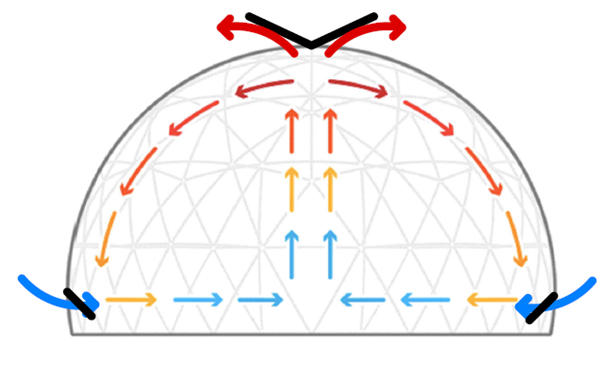
I wonder if putting a semi transparent white dome or covering over a city could effectively cool it by reducing net sunlight. Kinda like permanent artificial clouds
It'd probably heat it up because of the greenhouse effect, just from the hot air coming from all the cars and people not being able to escape, let alone heat from sunlight not being cooled by breezes/convection
It'd be interesting to see if there were some economies of scale for heating cooling.
For example, I could imagine that a nuclear power plant in the center of the city could provide the whole city with both heat and power at a fairly low cost for both.
On the flip side, you might be able to do city wide geothermal cooling.
It'd be an interesting experiment to say the least.
Europe already has utility heating. I know I first heard of it from Cities Skylines and my first thought was "That sounds like a silly excuse to add another utility." Then I looked it up and found it was a real thing. NYC has a steam network which has remarkable versatile functions - in addition to heating, resturant dish cleaning, and humidity control.
Deepl: "In a high-rise building of this size there are many toilets and accordingly many soap dispensers that would have to be refilled. Not so with Euler-Hermes: a central dispenser in the basement is filled with 200 litres of liquid soap, and a pump "shoots" the cleaning agent with nine bar pressure into the 200 dispensers on 22 floors. Practical!"
I think that part of the comment was specific to the game Cities Skylines. Like, "Oh they added another utility to manage... wtf is this? I haven't ever heard of cities doing this." But then they looked it up and found out it's a real practice.
There definitely are economies of scale for heating and cooling, and doubly so when you're generating electrical power as well; this is known as "cogeneration" or "combined heat and power". Generating electrical power inherently generates waste heat as well, and a perfect use for this heat is generating steam and/or running an absorption chiller.
The canonical example is the combined heat/power/chilled-water plants often found in university campuses. There's a gas turbine, usually running on natural gas, and its hot exhaust gas is used to make steam. The chilled water is usually generated by variable-speed centrifugal chillers, which are remarkably efficient machines compared to smaller-scale refrigeration systems. Nowadays, there's centrifugal chillers that don't even need oil in the refrigerant to lubricate the bearings because the bearings are active magnetic bearings (like in turbomolecular vacuum pumps and uranium enrichment centrifuges): the shaft with the turbine/motor is made to levitate and a computer actively controls its position to micrometer accuracy. Oil-free magnetic bearings not only eliminate a source of frictional loss but also allow for more efficient heat transfer in the heat exchangers (https://mnashrae.org/downloads/Presentations/magnetic_bearin...) because there's no oil to provide unwanted insulation between the copper surface and the refrigerant inside.
Since a single entity controls the buildings and the utility tunnels alike, there are steam and chilled water pipes going to every building. In each building the steam is passed through heat exchangers to heat potable/domestic hot water and also heat hot water that'll be used for heating air. (It's also possible to have a single-phase system where no steam is generated at the central plant -- just hot water; apparently there are efficiency gains from doing so). The chilled water is directly used for cooling air. Equipment that needs heating or cooling can be plumbed into the facility's heating hot water or chilled water systems, rather than requiring their own (smaller and less efficient) heating or vapor-compression refrigeration systems.
The electricity generated on-site might be somewhat more expensive than grid rates since your utility's large-scale generation facilities are hopefully more efficient. In exchange, the waste heat from the generation process -- which would otherwise be discarded -- will keep your buildings and equipment warm for free (well, for the cost of moving steam / hot water around and maintaining the system).
You can be clever and throttle your gas turbine based on the facility's instantaneous electrical / chilled-water / steam requirements (and even import power from the grid if it's economical); or run the chillers a bit more than necessary overnight (and store the chilled water in tanks) so during the day there's less load required on the system.
Normalizing it to the outside temperature would be a matter of airflow, unlike heating, which requires energy from somewhere. Running fans would not require much energy by comparison.
Technically but there is a matter of expense and lack of crossbreezes for a solid dome and indoor air pollution issues. Active ventilation is a possibility but it seems like it would be of questionable worth unless the outside is far worse.
I love coming up with ideas for future cities. I have previously even hired digital artists/CAD developers to help me illustrate my ideas.
To me there are lots of obvious structural things that are outdated about cities. And it is fun to think of out-there concepts to radically change or maybe improve things.
Recently I was in Gravity Sketch making a 3D model in VR of part of my idea. That 3d model looks terrible now and has only about 40% of the concepts included. Right now it is a series of connected enclosures, sort of like domes but sort of not like domes.
Basically there will be like a grid of these enclosures that are connected by two or more levels of roadways for small autonomous cars (pods) -- most of which will be for single passengers.
Each megastructure is a little bit like a tree inside of an egg. Spiraling along the internal edges will be roads for traversing the levels. There will be something like 7 or 8 vertical levels, each of which is maybe 4 or more stories tall. The branches of the tree are steel holding up platforms.
Each main level has two sub-levels: one for infrastructure, and one for people and buildings. The infrastructure level contains the roadways for the autonomous pods, as well as things like water, electricity, sewer, networking, and basement/cargo reception.
The main level contains multistory buildings, walking roads, and a significant amount of space set aside for a type of permacultural-landscaping. So there will be zoning requiring that space to be developed as for example food forest with aquaponics built in. This will be on all levels and platforms. So in the city charter or whatever is this requirement to dedicate a certain amount of space to this type of agriculture which is also landscape. The idea is not to realistically produce all of the food or even a great proportion of it, but to enable some fresh produce to be at hand and to ensure that people are connected with food sources. The idea is that by making agriculture a more integral part of the city, there may be more attention placed on agriculture by ordinary people and there may be more attention placed on making it more sustainable or something. Also it seems wasteful to just use landscaping for decoration.
Another aspect is that I would like alternating bands of facade on the egg. So there will be strips of something like glass but which will permit UV B (required for Vitamin D production) in a double layer. And then strips of a thick insulated layer with an energy-harvesting sheathing that incorporates solar panels and ducted wind turbines sort of embedded in tunnels in the solar-cell-covered undulating surface.
It seems that you would need strategies for passive and active heating and cooling. Such as automated shading, opening and closing ventilation, and heat recovery ventilators. Etc.
It would be nice if some type of glass could be used largely for central walkways in order to increase the penetration of light.
Anyway I have a bit more that I wrote up before.
Multi-Level City Concept
In a high-density urban core, many skyscrapers exist in a relatively small area. This makes it possible to house many people and support many businesses in that small footprint.
However, in these areas, while most buildings may have 50 or more floors, there is only a single level containing public infrastructure: the ground level, which contains all of the vehicle transportation, water, sewer, electricity, and communication.
In this scenario, there is actually more private infrastructure in the buildings themselves than infrastructure in the public level. This is because each structure is a self-contained, privately designed and privately maintained entity. So transportation (elevators), electricity, communication, water, sewer must all be facilitated by each private structure. In addition, each of these is connected to the public infrastructure on only one level.
This presents multiple problems.
Problems with Single-Level Infrastructure in Many-Level dense Urban Cores
Since vehicle traffic can only move on one level, congestion can be extreme.
Multi-Level Public Inter-Building Public Infrastructure for Dense Urban Cores
Supporting Autonomous Passenger and Cargo Delivery
Suppose that there was a way to build a type of multi-level skeleton for a city. So instead of a single roadway at only ground level, there were several different roadways at different floors of a superstructure. This superstructure would be designed to support the installation of modular construction.
With this system, delivery of goods by small autonomous vehicles could, for example, proceed directly from the back cargo door of a restaurant on level 8, to your front door on level 2 a few blocks away, strictly over the public roadways which connect not only different buildings but also at different levels. Vehicles could traverse levels over graded roadways or perhaps some type of small vehicle elevator system.


There's a lot of space in Montana, Wyoming, the Dakaotas, and we'll need more space for population there as we have to migrate north.