A bunch of my friends have a routine of playing a whole host of wordle variants daily. It's been amazing to watch.
dordle/quordle/octordle: Play 2, 4, or 8 boards at once. I find quordle to be the sweet spot.
xordle: Just one board but two secret words. A more puzzley feel. I made this one.
squardle: Sort of a crossword of wordles doing 6 at a time. Your feedback has some spatial meaning rather than all the puzzles and hints being done in parallel.
semantle: Guess the word based on similarity of meanings rather than spelling.
worldle: Guess the country/territory by its shape.
chessle: Chess opening moves.
ordsnille: Swedish wordle. I don't know Swedish but I do this one, using 5 letter words I find on the page then guessing plausible words. I'm slowly building up a valid word list by playing.
So I think even if the NYT acquisition is distasteful to you, maybe Wordle still is an example of nice things we can have.
I think it is so cool how the popularity of Wordle has opened the door to so many games that expand on the concept. It is like it created a shared expectation for how games like this can work that has now been adapted and expanded by so many different creators. I don't think any of the variants would be as popular without the original being as culturally prevalent as it is.
If you want to try one more I made squareword (https://squareword.org) which features a 5x5 grid of letters, featuring five words down and five across. Like a combination of sudoku and Wordle.
One small feedback on squareword: it'd be very nice to do some word pruning a la Wordle to exclude rarer words that the average person is unlikely to know (or have any exposure to), like today's first row, 4th column, and 5th column. IMO brute-forcing words until you get a word you've never even seen before isn't very fun.
There are a bunch of lists out there for these variants. I wrote a small one as a weekend project to learn React and AWS. People seem to like it since I've only shared it on my personal FB and it's getting hundreds of hits a day. I'll plug it here since you seem like an "rdle" lover.
want to add one more? I've been making a clone that isn't different from the base experience but focuses on challenging friends instead of the once a day thing.
sedecordle (https://www.sedecordle.com/) - 16 at once. I think I'd like this if I could open it on a big screen and see all the words side by side, but as it is there's too much scrolling. I agree that quordle's the sweet spot.
I'm amazed not a single comment here has talked about these Reddit projects: Place and The Button were insanely notable when they happened. I am blown away to learn the same guy was behind them.
I assumed Wordle was somewhat of a one-hit wonder, but it sounds like Josh has a knack for making some pretty popular online phenomena.
It’s incredible to me that one person has had such a large impact on internet pop culture. I wonder how many distinct individuals have been regular users of his games.
I think it is a one-hit wonder. Obviously the button and place were popular games, but they were instantly shown to a billion people when launched. They could have launched tic-tac-toe and it would have been popular.
I don't think that's true. It's difficult to convey the amount of overnight culture that came from
"the button". It wasn't a game for many people, it was an absolute obsession for months to hundreds of thousands of people.
It's very easy to discount if you weren't there, fair enough.
Thank you for bringing this up; I think a lot of programmers might look at Wordless, see a seven-figure payout, and beat themselves up for not managing to do the same when their experience level is vastly different.
Yeah, there's a ton of barely noticeable nuance to Wordle's design that makes it so popular. The way sharing was set up was brilliant, and the "everyone gets the same word" design feels super limiting and strange, but you can instantly see the tie back to his earlier projects where that makes it more of an experience/event than a simple word game. Things like Place and The Button having hard set interaction limits changes what they are and how people play them.
The usability experience is absolutely top notch as well, I can't speak to any input or interaction method that feels natural that Wordle doesn't seem to handle effortlessly.
It's a simple game, but it's a game tuned to the absolute perfection of it's craft.
The thing that makes Wordle successful to me is the fact it allows and encourages actual social interaction, not the fake "social" of having to hear what every yahoo has to say about something. I don't post mine on Facebook or Twitter but my friends do and it's nice to have a small fun thing to chat about. I talk to my wife about it once we're both done. We need more of these kinds of things that are social without being "social".
It's fun because it became a viral literally everybody I know started doing.
I'm a bit burned out now after doing all of the variants every day and trying to be overly competitive squareword, quardle, octordle, sedecordle, worldle, heardle.. there's too many now
It was certainly very iconic in the Netherlands (coincidentally I just gave a lecture about it this week, based on [1]), but it has aired in a number of other countries as well, such as the US and France. I think the former even is the original [2].
Shouldn't be too strange that people might want to play a game themself instead of watch other people play a game they never knew of on TV in Dutch.
There are probably a lot of good games out there that could be thoughtfully ported so that people can play. But you'll find that a naive clone by itself doesn't guarantee success.
Game concepts generally can't be copyrighted, in the US at least.
From Wikipedia [1]:
> gameplay elements of a video game are generally ineligible for copyright
> It’s still unclear what went down legally between the NYT and the Wordle Archive, but a spokesperson for the news outlet vaguely told Ars Technica that the archive’s “usage was unauthorized, and we were in touch with them.”
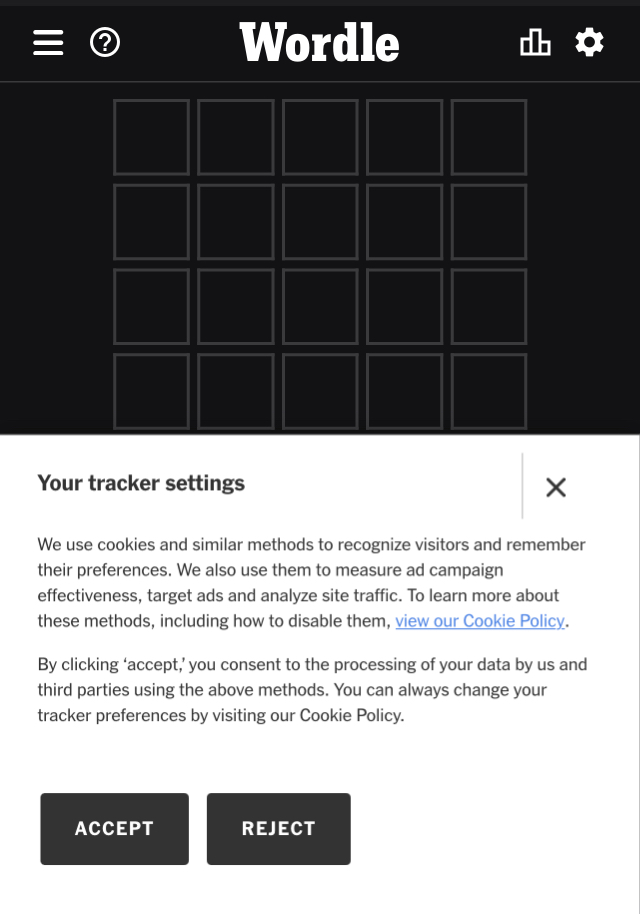
They;re still trackers and there's no reason to think that data collected for "analytics" isn't also used for "advertising", or for "selling to the highest bidder if we get desperate enough for money".
Wordle may or may not be proof but there are plenty of nice things on the internet. Tons of personal blogs, tutorials written by experts for fun, etc. It might be true that on average, random articles are horrible, especially on mobile where every 4/5ths of a screen a new animated ad appears (I just leave the site). But, for there's still plenty of sites made with TLC
If anything, Wordle is proof that we can't have nice things. It is now full of privacy-eroding trackers [1] and nonsensical, inconsistent, and seemingly arbitrary word bans [2] -- wherein words like "agora" and "slave" have been removed, while words like "fucks" and "cunts" are apparently just fine.
edit: it seems like sometime today, NYT re-added the previously-removed words like "slave" or "agora" or "wench" or any of the other words which up to today had been removed. That is interesting timing - did someone read this comment, or just coincidence?
"slave" wasn't removed. It's still a valid guess word, as are both "fucks" and "cunts" (I just checked, and still got today's word in 4). All the NYT did is 'demote' it from the special list of daily words because, fairly obviously, the NYT belive the optics of using the word as a way to make money is a bit complicated. There's no good reason why the NYT shouldn't have full control over an app they paid upwards of a million dollars for...
Up until today 'slave' (and 'agora', and 'wench' and etc.) was removed. It seems like starting today NYT has reinstated the previously-removed words. Interesting.
I think the issue was that words in the 'word-of-the-day' list are not repeated in the dictionary, so removing them from the 'word-of-the-day' list meant they were also no longer valid guesses.
Presumably this was pointed out to the NYT, and at some point they fixed the bug by adding any words removed from the 'word-of-the-day' list back into the valid guesses dictionary.
My guess is that they deemed it a little bit too obscure, but I don't know that and can't imagine the process used and there are probably plenty of words in the list to point at and quibble over.
One of the things about Wordle is that it can give you a good shot at a feeling of success. Having something that feels like an "obscure" word which causes you to fail, lessens that positive feeling that could keep players returning every day.
The list of possible solution words is different from the list of words you can input as a guess. “Agora” and “slave” were removed from the input list (they’re back now).
Do you know if they were also removed from the solutions list? My only guess is it was an internal communications problem, and words removed from the solutions wordlist got removed in the guesses wordlist too.
The way wordle was coded, the solutions and guesses word lists were nonoverlapping. When you guessed a word it would check it against both lists. So when NYT removed words from the solutions list they should have added them to the guesses word list so they could still be guessed, but they didn't. An easy mistake to make with an unfamiliar codebase.
There don't seem to be any offensive uses for agora. Check the Urban Dictionary if there's ever a doubt. So that one might not have been pulled for PC reasons. Maybe they thought it was too archaic.
Well, a 3000 years old word is indeed quite archaic - but it is routinely taught in schools in France so that's the reason I may have not seen it as such. Good idea with the Urban Dictionary, thanks.
I think it’s proof that you can’t have a thing exactly as you want it forever for no cost. And if that’s something a person needs proven to them, better learn the lesson through Wordle than something that really matters.
Can anyone explain why "agora" (a Greek word meaning "market") was removed? I can at least perceive the motive, as silly as it is, behind the other two, but this one has me stumped.
They removed it simply to break parity with downloaded versions of the game. It was on the day that Agora was supposed to be played that the two diverged forever and locked you into playing on NYT if you wanted to play the same puzzle with all your family and friends.
And it made the NYT version a two-days-ahead spoiler for any clones of the original, which was quite effective at getting whole groups of people to move instead of using clones.
It is too obscure. Source: I am a fairly smart and well-read person and do not know the meaning of the word. You can't have a word that difficult in a game that has a win streak...it is like a reverse deus ex machina or something. Bam! You lose your streak for no reason!!!!
Counterpoint: You break your streak on a word you don't know. You get upset and look it up to see if it's even a real word. You discover that it means a Greek market, and start learning about that culture, maybe a little history.
Maybe you're pushed to learn other 5 letter words, to prevent yourself from losing your streak again. Maybe you start reading more because you want to expand your vocabulary.
All because you lost a precious game streak because you were pushed out of your comfort zone.
I do this on Worldle constantly since I find the geography interesting and gives me a reason to explore a little history briefly outside of the heavily Eurocentric world history I got in school.
But I'd still be annoyed at having to look up a word I never would use in real life. The countries actually exist and are possible travel destinations.
I really wish they would give definitions (or at least link to a dictionary) for all guessed words after playing - especially for all the clones like quordle/octordle where they often use weird words. I would send feedback but there's no contact information on any of these games.
A measurable fraction of people who break streaks simply stop playing. Missing that dopamine hit of your streak counter incrementing (and being higher than your friends) can be worse than having no streak feature at all.
'This is why we can't have nice things', which is what my comment (and likely the article title) was referencing, is an idiomatic, not a literal, expression [1].
I think there are several nice things on the Internet. They're mostly run by individuals or non profits. Startups or large companies run the most visited sites and that more or less takes over the internet experience for most people.
https://archive.org is still an underrated corner of the internet. Other sites like LibreVox, Project Gutenberg, several blogs run by individuals, webcomics (xkcd), small merchants, community sites, MOOCs (private and large ones) etc. who are all great and I can't think of any way other than the Internet to get access to them. There is a centralising effect at work (e.g. people use discord rather than personal forum sites, medium instead of personal blogs etc.) but it's still not a dead end.
I think treating the net like a resource rather than a "way of life" or a something to binge on is the good way think about it. The latter is what companies try to make us do for their bottom line but that doesn't mean that it's the only thing out there.
You're right, there's plenty of cool stuff still on the web. Created by a single person or small team, and designed to be "home cooked", i.e. not a "product".
The problem is that "product" people invest in SEO and paid search/paid social so they're easier to find online.
"Creator" people are happy if only a handful of people use it.
I agree. During the early days of my exposure to the (pre Google) internet, friends used to tell me URLs and I wrote them down in a pocketbook to chase them later. Every site was something new.
Now, everything is responsive, minimalistic, using one of 5 or 10 CSS frameworks. There's definitely progress but there's also something lost.
You can still play the actual Wordle (and access all past, and apparently future, games) here, ad-free, monetization-free, gripe-free: https://timewarple.com/
I played Wordle for a month before it was bought by the NYT. When it was acquired, I then binged a bit on the archive site, but then I stopped playing Wordle at all. Interestingly, I also stopped playing Spelling Bee, which I used to play regularly.
I think it's because I know if I play one game I'll end up wanting to then play the other, and it just becomes a time suck. Before the NYT bought it, playing Wordle didn't trigger me to play Spelling Bee (or vice-versa), but now it would — so I end up playing neither. Weird!
I do it early every morning while my wife scrambles to get it done before midnight. She hates when I read over her shoulder, knowing I'm aware of the word.
I chose to because I'm sick of seeing shit about wordle multiple times a day. It's going to fade away and no one is going to remember what is is in a year. It's just an annoying fad and an uninteresting little puzzle. Yet I keep seeing it everywhere dozens of times a day.
“My idea was that this should only ask for three minutes of your time,” Wardle told me. “It doesn’t addict you, it doesn’t record your data, it doesn’t track you, there was no way to pay for it or run ads against it—basically, it was designed not to go viral.”
Sounds like it was a design failure then, by the creators own metrics
To offset all the negative comments, I'll agree with the premise of the article: Wordle was a nice thing that didn't seem to have any of the negative emergent behaviors of his past projects.
It's a fun thing that everybody in my family does and gets to chat about every day. It's very cool that a guy wrote a piece of software that has positively impacted millions of people, and it's very cool that he was able to make money from it, and it's very cool that it is being supported and maintained in perpetuity by its new owner.
I also don't understand all the complaining about ads and trackers. I guess every single person here releases every project completely out of the goodness of their own hearts without any analytics or ads or any aspirations to monetize it? If so, good for you, but just because something may be monetized (probably tastefully) at some point in the future doesn't take away from the fact that a cool and fun thing was created.
> [...] just because something may be monetized (probably tastefully) at some point in the future doesn't take away from the fact that a cool and fun thing was created
Just because something may be monetized at some point in the future doesn't mean tracking your users without their consent.
It's likely a location-dependent notification, based on regional laws and regulations. Disabling cookies probably also disables it storing your notification.
Monetizing small projects is a fool's game, because the amount that application authors make is tiny. Ad platforms on the other hand, they certainly benefit, because they capture the long tail of applications and get access to a wealth of information.
(in fact, if anything, the fact that applications are only used by a small userbase is a benefit to ad platforms -- because it provides precise detail about the kind of applications that particular users have installed)
If your application becomes extremely successful, then certainly you could consider adding monetizing strategies to pay yourself and the infrastructure costs of the service. But what are those costs? They can, in many cases, be tiny - especially if you allow your application to run on the user's own device.
Monetizing using advertising doesn't seem to make a lot of sense to me for most software authors, and I think it's an unfair system where authors and users both lose out.
> I also don't understand all the complaining about ads and trackers.
Then be clear about your intent to make money. If you have a product, sell it. I'm tired of being treated like a rat where my life is a maze with god knows who or what watching my every move trying to think of ways to coax money out of my wallet while selling that data to fatten theirs continually. Stop with the "strings attached" freemium crap, analytics behind the scenes tracking, and dark pattern BS. I used to be happy to pay a few bucks for a good app. Now everyone thinks their entitled to continual money streams from ads.
I agree with you but This is a consequence not an active decision. Digital advertising is highly profitable. If we want less ads and trackers, make that not so with a heavy advertising revenue tax. Wordle would never have gone viral with even a $1/month paywall. People (writ large) don't care about privacy and have embraced the ad model. I think a patron based system is the best avenue forward for indie content given where we are now. People will balk at a subscription for anything that is free today.
> I guess every single person here releases every project completely out of the goodness of their own hearts without any analytics or ads or any aspirations to monetize it?
Barring work, where I don't really have a say, my own projects have at times included usage metrics, it's always been easy enough to switch them off, and the goal has purely been a "how is this used" rather than "give me data I can sell for a dollar to GloboAdTech(tm)".
Nothing gets to stay as just itself. It has to bend and change to work within capitalism, to generate wealth for whoever owns it..
I'm happy for Wardle, it was a nice payday for him, and shifts the ire for any percieved "issues" away from an individual. But I can also mourn the loss of a "pure" thing to the maws of profit-driven ventures.
Maybe it isn't bad yet, but you'll forgive us, for having seen this stageplay numerous times before, and instinctively humming the next song where things get bad.
> Nothing gets to stay as just itself. It has to bend and change to work within capitalism, to generate wealth for whoever owns it..
This is not an inevitable conclusion. I can cook brunch for my friends without requiring it to be a capital transaction in the marketplace or without the eventual goal of opening up a pancake store.
Barring work? So basically you do the same but hide under the cover it’s your work? The same work you chose and where you could decide to quit if it was really against your principles? You do have a say. You have the ability to walk away.
Never seen someone on such a high horse they're suffering hypoxia.
Not all of us can work on eco-collective shade-grown organic carbon-neutral farms for orphans and kittens, such as yourself.
And, to clarify, the most we do with analytics in work, is usally plumbing in Google Analytics (satan, the devil, belezbuub yadda yadda) and wiring up the metrics/actions for that site/apps particular flows to give data on who comes from where for marketting contracts, and how effective certain areas are (are people dropping out during checkout? Do people struggle with using x feature? or do they just never open it?)
You’re right - Wordle shows that we can’t have nice things. Newgrounds, on the other hand, is still running strong and is proof people don’t actually want the old internet they claim to want.
All decent moderation has a tinge of bias to it. Otherwise trolls and saboteurs will pollute the conversation with bullshit.
But the idea someone is calling NYT evil without evidence or explanation, as if it is so self-evident as to not need any more, tells me what I need to know about the comment.
No, because it got bought by NYT. It was absolutely glorious as an indie phenomenon but to see it fold into a giant media conglomerate so quickly is yawn
The most epic move would have been to pull the plug on wordle right at its peak, which was about two weeks ago. Not sell out. Just rip it out clean and let a thousand sorry clones try to compete for crumbs. That would've been an awesome statement.
It's amazing to me how HN nonstop celebrates everyone raising money on bullshit rehashed tech ideas but are shitting on this guy for selling to NYT. He built and sold something unlike the vast majority ever will.
Maybe he needed to sell some of it to the NYT in series A, with another round after 6 months to 2 years, but being careful not to go too soon or too late.
After correctly judging the runway and managing the burn rate following series B, more marketing and branding before series C would maximise value for the creator.
Oh I don't mean to shit on the creator. We all got bills to pay. Mad props to him for getting a great payout and moving on. But does the result count as a "nice thing on the Internet"? I can be the judge of that and IMO no at this point it's just one of a million free casual games awaiting some monetization bullshit.
> But does the result count as a "nice thing on the Internet"? I can be the judge of that and IMO no at this point it's just one of a million free casual games awaiting some monetization bullshit.
I don't understand the thought process. NYT has a bunch of daily mini games that are free and have been for a while. Only the full crossword and the archives are paid.
Did you write this comment before doing any research into how NYT handles their games?
> Did you write this comment before doing any research into how NYT handles their games?
I'm somewhat aware of how it works.
> NYT has a bunch of daily mini games that are free and have been for a while. Only the full crossword and the archives are paid.
Well it's like I'm a fish complaining about the fisherman's worm having a hook in it, and you're saying but at least there's a good worm.
Free tier games on NYT clearly serve as feeder for subscriptions. Here's an example of NYT juicing someone's "high" following a free game of spelling bee, in order to push them to subscribe.
I hate this kind of manipulation. Again can't blame the NYT for responding to competitive pressure but the free portion of their game is such an obvious attempt to hook gaming subscribers that I personally really don't see it as a "nice thing".
You can't have your "mad props" and eat them too. Either he sells and you have to suffer the horror of a nag screen to get a free game, or he doesn't, and you don't.
Because it was a comment written without having any context into how NYT handles their games. They assume something about massive monetization that would happen in the future, when the daily wordle will likely remain free forever, just like most other daily games that NYT has.
I do think there's a ton of nice things on the Internet. The FOSS community as a whole and Wikipedia are astounding in their civilization-transforming, anti-capitalistic effect on society. 20 years ago people paid Microsoft for the only half-decent productivity software around, Internet Explorer and freaking Encarta, for crying out loud. I don't think wordle is nearly close to the same level especially after getting bought.
One can be happy for the creator’s individual (and deserved) success, while at the same time begrudge the fundamental change brought about by its acquisition.
Simply saying “everyone shits on this guy” is not really helpful, or accurate.
The people who show up in "tech person does a thing" threads to fawn over said tech person are probably not the same people who complain about ad surveillance by the NYT.
If you call numbers I call for sources. If I'd give in to my subjective observations, I'd state the opposite. I have never played Wordle, nor did I talk with anyone about it, nor have I heard anyone talk about it (in person ofc). I don't use Twitter though...
Maybe you're right, but I'd like to see proof of this. After a quick search I found than:
- Flappy bird was downloaded 50M times [1]
- The dev made 50k a day [1] which implies that those 50M were not all 'dead downloads' but actual users
- About wordle, every article I find just states 'more than a million daily players' [2]
So, to make this short, I think you're just picking random numbers that fit your subjective perception. If you can provide proof that says otherwise I'll gladly back off. In the meantime it'd be nice if you don't make any more comments about how many times wordle is bigger than flappy birds then you already did. Your turn.
(not gp) Google trends favors wordle, with the peak being 5x as big for US and 3x worldwide [1]. Google trends is imperfect information, but it is evidence.
I think the comparison you did is hard to evaluate. the dev of wordle made 0k a day until sell, so that is an awkward comparison. The 50M downloads is hard to compare to 'more than a million daily players'.
Anyway, the difference between US and worldwide in google trends may point to some differences in experience, too. Wordle is quite big in the US, while flappy bird was bigger elsewhere. I'm not american and my experience matches yours, so just for fun I'm going to predict you are not american, but gp is, with 2:1 odds. Am I right?
Beware of comparing Google Trends data from different dates - the data is not "normalized". Consider, is it likely that "music" and "internet" are decaying in popularity - at the same rate, even?
I like the idea of comparing this via google trends! I didn't think of that option. I'll keep that in the back of my head for the future. Thanks!
Yes, I was aware that this is hard to compare in several aspects. Besides the money, you already talked about: One is something you have to download and the other is something you just visit a website for (That's the reason I mentioned the money and that those dl are not 'dead'). My aim was only to show 'something' that could make some comparison possible at all.
The commenter I initially replied to itched me the wrong way. He made his argument in more than one comment but even the two I read weren't consistent. Once he stated 20x bigger, in another comment it was 10-20x. I personally don't have a problem with wordle being bigger than flappy bird ^^ but the way he presented it seems random at best.
And, one more thing... I'm not American ;) +Edit: Earlier I shortly skimmed his/her profile and if I remember correctly he/she made a comment on something about the traffic in CA (or some US city)
Weren't most people going straight to the app store to download flappy bird? Not an option for Wordle. That should invalidate the Google Trends comparison.
Also since Wordle isn't on a nice wordle.com domain, my assumption is most people have to re-search for it frequently, boosting its Trends history.
Google trends just looks at search terms and counts them, or what does it do exactly? If so, you've got a point here.
Some contra-argument would be: There is more to it than just download (or play) something. For example all the articles, publicity, score boards and everything around it that rises when something gets popular. And this stuff does correlate with popularity (and search terms). Maybe those who downvoted you can clarify what they mean...
Yes i used similar data. Zooming in on Flappy bird, it also had a peak of search interest after the announcement of its removal on Feb 8, 2014 (supporting that more people likely learned about flappy bird after its removal was announced, than before)
In the game? We lost AGORA, FIBRE, LYNCH, PUPAL, SLAVE and WENCH.
In our culture?
We lost the spirit of prioritizing reasoned debate over “the narrative” and “the optics”.
We lost the standards we had for challenging each other to grow and traded them in for incentives to solve problems with performative appeals or procedural machinations.
I didn't, but I'm admittedly not the typical user. I right-clicked and saved the Wordle page some weeks ago and have enjoyed my ad-free and non-tracked Wordle with original word lists ever since.
It's unusual that it is made this simple, and that's exactly because Wordle was conceived as a whimsical playful thing with viral potential (the creator had viral hits before), not as a money-making machine.
I have nothing but thanks and high praise for Mr. Wardle.
I mean this sincerely as a fellow HN user and human - stop looking at everything through a culture war lens. I'm sure you'll think my post is ironic, because you see the world at war with you. But take three minutes and meditate on the fact that maybe it isn't all evil, that not every little social adjustment you observe is part of a coordinated downward spiral.
I think just speaks to the age we live in now; everything has to be relentlessly analyzed. When Wolfenstein came out in the early 90s, nobody cared that the villains were Nazis. When a reboot came out some years ago, suddenly there's a need for 'discourse' about historical accuracy, and whether the Nazis deserve to be killed in a fictional game, and why there side of the story isn't emphasized.
Wait, there was really a "won't somebody think about the Nazis" movement? I'm curious to read more if you have a link, especially if this was more than a fringe group.
The illusion of innocence? The perspective that it might still be possible, on a shoestring budget within reach of a modest person, to create a massive, worldwide collective experience, that is engaging and fun without having any commercial ulterior motive?
User privacy, for one. The wordle page is now full of trackers. Freedom from arbitrary corporate decisions about which words are acceptable or not ('slave' is no longer acceptable, while 'cunts' is, for example) is another loss.
I use Brave Browser. I’m not an ad tech guru. I _feel_ that these various trackers you mention on this page shouldn’t have much (if any) purchase on my visits. But it could be a naive placebo effect. I’m curious from anyone who is more knowledgeable than me about whether what you mention is largely muted by using Brave, or if it’s just a feel good that actually does little?
I just checked; "slave" is an acceptable guess in Wordle, as is "cunts".
And I don't understand complaints about trackers; don't you know how to filter them out? I personally use Privacy Badger but there are many other choices.
> I just checked; "slave" is an acceptable guess in Wordle, as is "cunts".
Like I said in another comment:
> Up until today 'slave' (and 'agora', and 'wench' and etc.) was removed. It seems like starting today NYT has reinstated the previously-removed words. Interesting.
You can find plenty of news stories about it being removed in days before today, if you need a reference.
And knowing how to filter out trackers is not relevant to critiquing the practice of putting trackers in in the first place.
Let's say hundreds of thousands (or even millions) of people enjoy playing Wordle each day, and that they enjoy playing the "official" version for the sake of network effects.
Let's say you wrote this game for fun in a few days, and within a month, a newspaper (one of the better ones, IMO) offers you life-changing money for it.
You think it would be better somehow (morally? just to be "epic"?) that someone decline that money and tear the app to shreds so no-one can have a good time.
I don't see how that route is positive for anyone, except in the Joker-esque "watch the world burn" itch to rebel against the Man.
Perhaps among adults in the English speaking west. Flappy Bird got an enormous amount of attention, especially considering that it was made by a Vietnamese person (I think) and had very little marketing.



dordle/quordle/octordle: Play 2, 4, or 8 boards at once. I find quordle to be the sweet spot.
xordle: Just one board but two secret words. A more puzzley feel. I made this one.
squardle: Sort of a crossword of wordles doing 6 at a time. Your feedback has some spatial meaning rather than all the puzzles and hints being done in parallel.
semantle: Guess the word based on similarity of meanings rather than spelling.
worldle: Guess the country/territory by its shape.
chessle: Chess opening moves.
ordsnille: Swedish wordle. I don't know Swedish but I do this one, using 5 letter words I find on the page then guessing plausible words. I'm slowly building up a valid word list by playing.
So I think even if the NYT acquisition is distasteful to you, maybe Wordle still is an example of nice things we can have.